Ticks can transmit a number of diseases, the most important is Lyme Disease. We explain you how to prevent and remove ticks.

Ticks can transmit a number of diseases, the most important is Lyme Disease. We explain you how to prevent and remove ticks.
What are ticks?
Ticks are a type of parasite distantly related to spiders that attaches to the skin of dogs, cats and other animals by means of their mouth parts. Once they have fully attached, they inject their saliva and suck up blood. When ticks first attach, they look quite small, fairly flat and are not strongly attached to the animal’s skin.
They begin to feed and engorge with blood in the next couple of hours, they then grow large and rounded to about the size of a pea. Ticks are mostly found in grassy, bushy and wooded areas, including some gardens.
Why can ticks be dangerous? Lyme disease
Ticks can transmit a number of diseases, the most important is Lyme Disease. Some of these diseases are occasionally fatal to dogs and cats and often cause unpleasant flu-like symptoms, among others, that may persist.
Products to prevent ticks
Topical control products recommended by veterinarians such as Frontline are usually effective in preventing ticks or causing them to quickly drop off. Proprietary sprays, collars and powders can also be effective. Ticks may still attach and feed when using tick prevention as it takes time for the active ingredients to work, but the tick will die and drop off within 24 hours.
How to look for ticks on dogs or cats
Always check your dog for ticks after a walk, and check your cat regularly if he goes outside. Ticks can be found anywhere on the body but are most commonly found on the head near eyes and ears, on the neck, inside the back legs and under the tail around the anus. Ticks that have recently attached may often be removed by combing the hair, provided they have not had time to fully attach to the skin.
How to remove a tick
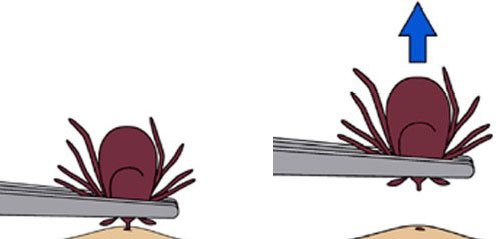
Veterinarians worldwide recommend the physical removal of ticks using fine-tipped tweezers. You can also buy special tick removal devices from pet stores that are simple to use and work in a comparable way.
In the picture below you can see what a tick looks like.
How to get a tick out of a dog or a cat safely and step by step
- Tweezers or the tick removal device should be used to grasp the tick as close to the skin's surface as possible. Compressing the tick’s body may cause fluids to be squeezed back into the bloodstream of the dog or cat.
- Pull upward from the skin using steady, even pressure. Do not twist or jerk the tick as this can cause the mouth-parts to break off and remain in the skin. If this happens, try to remove the mouth-parts with tweezers. If you are unable to remove the mouth easily with clean tweezers, leave it alone and let the skin heal.
- After removing the tick, thoroughly clean the bite area and your hands with alcohol, antiseptic or soap and water.
Dispose of a live tick by submersing it in alcohol, placing it in a sealed bag/container, wrapping it tightly in tape, or flushing it down the toilet. Never crush a tick with your fingers as it may still transmit diseases.
Removing ticks from dogs with alternative methods
Other methods of tick removal work in some situations, for example if the tick is in place difficult to reach such as near the eye or in an ear so tweezers cannot easily be used, or if no tweezers are available. Cotton wool may be dipped in liquid soap, nail polish remover or other similar liquids.
The soaked cotton wool is held around the tick for several minutes and it will then often fall off into the cotton wool. A chemical method is not recommended except if the tweezers method cannot be used. This method is discouraged firstly since the goal is to remove the tick as quickly as possible before infection may occur – therefore not waiting for it to detach.
Secondly, using chemicals will cause irritation or injury to the tick that may result in it vomiting infective fluids into the host, potentially causing the infection you are trying to avoid.